แสดงบทความที่มีป้ายกำกับ Cichlid แสดงบทความทั้งหมด

วันเสาร์ที่ 18 พฤษภาคม พ.ศ. 2562

Fish Data : Peacock Cichlid or Butterfly Peacock Bass, Peacock Bass, Eye Spot Cichlid


    The Peacock Cichlid Cichla ocellaris is an eye catching show fish for a very large aquarium. Its shape and large size cause many observers to mistake it for a type of bass fish, but it is in fact just a very large and colorful cichlid fish. It presents an olive-green body color which transitions into a yellow-white belly and is marked on the body and back by black blotches and stripes. But it's the distinctive ocellus or 'eye spot' seen on the tail fin that commands the most attention and that gives this fish its name. Reminding the observer of the distinctive tail feather of the male peacock, this tail fin has garnered the fish such common names as Peacock Cichlid, Butterfly Peacock Bass, Peacock Bass, and Eye Spot Cichlid.

    To be clear, this fish is not for everyone! It grows to a significant size of around 30" (2.5 feet or 74 cm) and will require a massive aquarium for optimal health. That being said, this fish is likely a perfect choice for those who want one of the most dramatic cichlids in the hobby. Just like cichlids of smaller sizes, Peacock Cichlids are known for their striking intelligence and ability to attach to their owners, and when they see you come into a room they recognize you. They will beg for food, splash at you for attention, and sprint around their tank to catch your eye. This cichlid is sort of like owning a small dolphin!

    These cichlid are moderately difficult to care for as they need to be housed in a very large aquarium, a minimum of 70 gallons. They appreciate a bottom of sand or gravel with some rocks and wood for cover along with some flat stones for spawning. They don't bother live plants, so these can be provided around the inside parameter of the tank while leaving plenty of open space for swimming. Peacock Cichlids are quite adaptable and don't require any special water chemistry, though they are sensitive to ammonia and nitrites and will need regular water changes.

      Because of their size, only juvenile specimens of the Peacock Cichlid are really suitable for the aquarium. They are also territorial and voracious predators, eating anything that fits in their mouth. In the wild they are rapid swimmers but in the aquarium they are more sedate, often lying motionless waiting for prey. Because of their size and temperament they do best in a species tank or with other large South American cichlids.

      Interestingly, the Peacock Cichlid is primarily known as a gaming fish. For this purpose they were legally introduced into modified canals and lakes in southern Florida, United States. One positive effect of their introduction has been an increase of both the Largemouth Bass and Redear Sunfish, which are also desirable gaming fish.

Because of their inability to tolerate cold temperatures they are confined to the southern part of those canals. They are unable to expand their range, so the fauna of the Florida Everglades has not been altered to the point of being at risk. However they were also introduced into Lake Gutan in Panama which produced significantly undesirable results, drastically changing the composition of fish populations in that canal. Do not release this or any other fish into a non-native environment as the consequences can be devastating.

Foods and Feeding

     This cichlid  is carnivorous piscivore in the wild that feeds on other smaller fish. They are a pronounced predator and unless captive bred, will heavily prefer live fish as food. Once tamed they may slowly be trained to eat cut fish, other meaty foods, and many prepared and frozen foods.

     They get quite large so ideally they should be fed a high quality pelleted food and large chunk foods such as cut up fish, crayfish, and earthworms. They may also accept such foods as bloodworms, tubifex, and ocean plankton. Feeding in smaller amounts several times a day instead of a large quantity once a day will help keep the water quality higher over a longer time. All fish benefit from vitamins and supplements added to their foods.

    It was at one time common place to feed cichlids meat from mammals such as beaf heart, red meat and chicken. These foods contain fats that the fish cannot metabolise which accumulate inside the digestive tract and cause blockages organ degeneration. Thus it is recommended to only feed these types of foods as an occasional treat, rather than as a staple.

Aquarium Setup

    Peacock Cichlid need a lot of room, a minimum of 70 gallons for a juvenile, though over 100 gallons is preferable. Adults will require at least 240 gallons with larger being better. They do fine with moderate water movement and strong efficient filtration. They appreciate a bottom of sand or gravel with some rocks and wood for cover along with some flat stones for spawning. They don't bother plants, so these can be provided around the inside parameter of the tank leaving plenty of open space for swimming.

    These cichlid require large open areas to swim freely, so the decor should be fairly sparse. A sump style filter and protected inlet/ oulets are a good choice. Make sure to keep other tank equipment like heaters protected as well. These large fish can easily do damage to fragile equipment, so be sure to protect your equipment as much as possible by hiding it behind rocks or other decorations.

Sex: Sexual differences

    An older mature male will have a nuchal hump on the forehead, but otherwise the sexes are only discernable during spawning.

Breeding / Reproduction

    These fish has been bred in captivity and is raised in ponds as a food fish. They are what is known as a biparental substrate spawner. Being so very large, there are no reports yet on successful tank breeding, but they will spawn in an outdoor pond.

     Peacock cichlid can lay more than 2000-3000 eggs, with larger spawners laying between 9,000 to 15,000. They lay the eggs on a large flat stone in shallow water and the parents will adamantly guard them in the typical cichlid fashion. They are highly territorial and aggressive when guarding their eggs and fry . The fry will hatch in 78 hours at 82° F (28° C). When they are ready to move on, they enter into open waters. The fry love mosquito larvae (blood worms) and will mature in less than 12 months. See more about cichlid breeding in: Breeding Freshwater Fish: Cichlids.


Credit :

http://animal-world.com/encyclo/fresh/cichlid/PeacockCichlid.php

https://www.youtube.com/watch?v=IDlQD9RmALE


วันศุกร์ที่ 17 พฤษภาคม พ.ศ. 2562

Fish Data : Oscar Tiger Oscar, Velvet Cichlid, Marble Cichlid


   These fish is a large, boldly colored South American cichlid characterized by its unique personality and striking intelligence. These handsome fish quickly grow to a maximum size of a little under a foot (12" or 33 cm)  and are experts at commanding the attention of anyone observing their tank.

    These cichlid are certainly some of the most personality driven fish in the hobby, and can actually have so much personality that their territory may extend beyond the tank. They will investigate any goings on in the room and can bond with their owners on a level that the smaller cichlids don't. They can be taught to roll over for food and can even learn to enjoy being petted. Sometimes they act prideful or spoiled and can be sensitive or moody. This fish can also be demanding, behaving just like part of the family!

     The adults in the wild are normally a dark color with orange around the gills, on the sides towards the back, and with an orange-ringed black spot at the base of the caudal fin. The scientific description of this fish is truly fitting. The genus term Astronotus means "ray-backed, star-marked" and the species term ocellatus means "spotted or eye spot". Several common names used for this fish are also quite indicative of its appearance including Tiger Oscar and Marble Cichlid. In earlier times they were actually referred to as the 'Velvet Cichlid'.

     Though wild caught Oscars are still popular and widely availabe, a number of striking and dramatic color forms have been developed and are similarly popular and available. While all of these color forms present unique and beautiful aesthetics, perphas the most attractive is the mostly solid red colored Red Oscar. Similarly, the Speckled Red Oscar, with a speckled solid red body and black fins, is another contender for the most dazzling color form.

    Other popular tank bred varieties include the Tiger Oscar which is very similar to the wild form but with more red coloring, and the Red Tiger Oscar with marbled patches of red pigmentation. The Albino Tiger Oscar, Albino Red Oscar, and all the various lutino and long finned varieties are also some more recently developed forms. In addition, some Oscars have even been artificially colored or 'painted' to increase their appeal. In short, there is no shortage of interesting and dramatic coloring and patterning of these fish, so no matter what you like you will probably like the Oscar!

   These fish are very easy to keep and make a great beginner fish. The only aspects of their care which might be difficult for a beginner are the facts that they grow very large very quickly and are not meant to be kept with other fish. As a large, predatory cichlid, they will need to be kept in an aquarium of at least 100 gallons or larger and will eat almost any other fish in their aqarium. It is thus recommended to only keep them either individually, as a breeding pair, or as a community member in a very large aquarium.

  Oscars are curious fish that love to play. Rocks make a good decor but must be securely placed on the glass bottom as this fish likes to rearrange its home. Live ground plants can be a challenge because they can be uprooted, floating plants or plastic plants often work better. They also like to explore new things and will enjoy an occasional 'toy' like a plastic ornament. They can live 10 years or more with proper care.

Tank Conditions

    At the base of the tank should be a layer of soft substrate. The softest substrates are fine-grained, so sand would be ideal. Oscars like to dig so a coarse substrate would scratch them.

The most natural look would be to place rocks and bogwood around the tank, but you’re free to choose any decorations. Make a couple of caves for each fish so that they have somewhere to hide away within their territory. Also remember to firmly fix the decorations in place.

This species will dig around objects when looking for food which can dislodge them.

Live plants are unlikely to be eaten, but they’re still not safe. Just like the decorations, plants may be uprooted while they dig through the substrate.

Use hardy plants so they can survive the trauma. Floating plants should be safe from damage, a good option is hornwort.

Ideal water conditions are in the range of 74-81°F, 6-8 pH, and 5-20 KH.

You don’t need any special equipment to keep the water healthy, just a filter to clean it and a heater to maintain the ideal temperature range. Most aquarium lights are suitable too.

Attach equipment firmly to the tank or they will suffer at the hands (or fins) of an Oscar’s digging. Keep the lid on because these fish are powerful and may jump, or force other fish to jump.

While they like strong currents in the wild, the filter outlet should create a strong enough current, so you shouldn’t need a water/air pump.

What Size Aquarium Do Oscars Need?

Oscars will need a fairly large aquarium, 55 gallons or larger is ideal. A smaller tank will cause them stress which will make them ill or more aggressive.

How Many Can Be Kept Per Gallon?

Their size and need for territory means each fish needs lots of space. Try 55 gallons for the first Oscar, then 20-30 gallons more for each additional fish.


Foods and Feeding

    They prefer to be fed a variety of live, meaty foods, but will readily eat pelleted, dead, or frozen food if offered. They grow quite large so they should be fed a high quality pelleted food and large chunk foods such as cut up prawn and earthworms. As they grow larger, they will particularily enjoy live foodstuffs such as goldfish, guppies, and worms.

    Meats from warm blooded mammals (e.g. poultry, beef hearts, pork, etc) were once considered a staple in the diet of all large ciclids. However, more recently it has been discovered that due to the high amounts and types of fats and proteins contained in these foods, (which do not occur naturally in a wild cichlid's diet) these foods should not be fed to cichlids. The fats and proteins contained in these foods can cause damage to a cichlid's organs and lead to dangerous intestinal blockages. If you find your fish enjoys these types of foods, be certain to feed them only as an occasional treat, not as a main course.

Breeding

    Oscar lays eggs, but most of them eats away first egg and second too. Female gives birth to eggs after 2 to 3 days of the mating process in batches of 100 eggs and in total, lays 1000 eggs within a period of a few days.

In the natural habitat, Oscar eggs often have a low success rate and only a few eggs mature into young adults but  if cultivated in captivity like  tank or aquarium , they have high conversion rates.

This point can be taken as a base while selecting rearing water tanks for your fish. After eggs are laid, within 72 hours Oscar fry hatch. If Oscar pair becomes upset, is in stress or feeling unsafe,

they  consume their eggs. Fertilized Oscar eggs will be light brown in color as compared to white colored unfertilized eggs. As Oscar fry are hatched, you should move them to a different tank to eliminate the risk of being consumed by parents.

Moving them to different rearing tank will raise their survival rate and they will start to grow and will require more and more space as they grow into a large Oscar fish. Female Oscar lay a large number of eggs ranging from 1000 to 2000 eggs on clean rocks.

Sexing Oscars
It is impossible to tell the difference in sex in case of the Oscars. Both male and female types lo alike and show no difference in length or size but you can differentiate them by looking at the shape of genital papillae located somewhat around their anal opening which is blunt and wide-mouthed in females.

Mating

     Mating starts with a pair of fish involved in activities like nipping, chasing each other, picking up sand in mouths and relocating it somewhere else in the tank. Once they decide to mate, they prepare an area to lay their eggs on.

    Oscars male and female pairs that are chosen for mating process should be minimum two years of age. It is an easy way to mate if you buy a pair of Oscar’s that are spawned and mated already at least once.

    These already spawned fishes spawn naturally each month. When you buy, do not forget to ask for spawning proof. In case you do not buy this pair, next option you can choose is to buy some juveniles,

   grow them into adults and wait till they pick up their partners naturally for mating. Choosing this option will cost you enough time in breeding process which can be 16 months and varies from fish to fish.

Breeding signs

    Pair of Oscars seen cleaning a flat surface expresses early breeding behavior. At the time of breeding, courtship behavior can also be violent.

Oscar tank mates

 Although Oscars can live on their own all alone and do not have any need of tank mates but some of the compatible partners are Black Convicts, Firemouth, Jack Dempsey, Chocolate Cichilds. Know More

How to get Oscars to breed

    Purchase a pair  that have already been bred in past and pair them off in your aquarium for successful breeding. Interbreeding different types of Oscars like Albino, Tigers, Reds, Whites, Yellows allows you to have more Oscars with most distinct and unusual colors.

You are able to interbreed Oscar types to come out with the most unusual colors. Large space should be provided to Oscar pairs while breeding, a breeding tank of 100 gallons is preferred. Breeding them is like a challenge which can be met if you are dedicated towards it.

Mating habits

   Oscar pair shows mating habits such as change in swimming habits, slapping tails, chasing and lip lock mouths. In worst cases, they sometimes attack each other.

   Oscars should be given varied diet, tank water should be changed twice a week to keep it clean to induce spawning behavior. When spawning behavior is seen in Oscars, there comes a need to provide the pair with a spawning medium which can be an upturned dinner plate.  Ceramic surface is also suitable to lay eggs.

credit

http://animal-world.com/encyclo/fresh/cichlid/Oscar.php

https://www.fishkeepingworld.com/oscar-fish/

http://www.fishxperts.com/oscar-fish-care/

https://small-pets.lovetoknow.com/fish/oscar-fish-care

https://www.youtube.com/watch?v=A1a-GetRJxM

วันศุกร์ที่ 10 พฤษภาคม พ.ศ. 2562

Fish Data : Nicaragua Cichlid or Spilotum, Moga, Butterfly Cichlid, Macaw Cichlid


   These fish is really a spectacular looking fish. The males tend to be larger than the females, but it is the females that display the most dazzling colors. The coloring of these fish depends upon their place of origin in the wild, but arguably the most striking composition includes a brilliant gold body, a bright blue and emerald coloring on the head, purple accents under and around the pectoral fins, and blue along the edges of the dorsal and anal fins.

    Nicaruagua Cichlid is known as one of the most dramatically colored fish as an adult, as a juvenile they present a rather drab, brown aesthetic. Due in part to this lack of interesting coloring for much of their lives these fish can often be hard to find and are not a common inhabitant of the aquarium hobby. But when the hobbyist is able to obtain them they offer an unsurpassed spectacle in the aquarium.

     Other popular names for this fish include Spilotum, Nicaraguense, Moga, and Nickie. In addition, the brilliant array of its colors has prompted observers to liken it to other beauties of nature, inspiring the common names Butterfly Cichlid and Macaw Cichlid. Some sources also call it the Parrot Cichlid, but be careful when identifying this fish by this name as the name 'Parrot Cichlid' is also much better known as belonging to another cichlid, Hoplarchus psittacus.

     This is a great fish for both beginning fish keepers and advance aquarists alike. Like all cichlids it is territorial and has the capacity to be aggressive. However, it tends to only be a moderately aggressive fish and is more peaceful and reserved than many similarly sized Central American cichlids. It can be kept with other smaller cichlids, but avoid the more aggressive types like the Texas Cichlid or the Red Devil.

      Nicaragua Cichlids love to have places to hide and territories to defend, so be sure to decorate their tank with plenty of rock caves, flowerpots, and other such structures, and provide them with a sandy substrate to dig in. Since they are large fish and enjoy digging in the substrate, make sure all tank decorations are firmly grounded on the glass bottom of the tank to prevent toppling. They are fairly safe with live plants, but might have a tendency to nibble and bite at them, especially during spawning, so keep an eye on any live plants in their tank.

       These fish can accept most things offered. Feed a varied diet including dried pellets and flakes, frozen foods such as bloodworm and prawn and the occasional live earthworm treat for the best growth rates and colouration. Also try to ensure the fish receive some greenstuff in their diet. Blanched spinach or spirulina-based dried foods both work well.

       Possible. It spawns in caves. Obtaining a pair is not the easiest thing in the world, as the fish are very aggressive towards one another. The best option is to start with a group of 6 or more young fish and allow them to pair off naturally. Furnish the aquarium as suggested above, and condition the fish on a good diet. Once a pair forms they will be seen defending a territory against all-comers and at this point it’s wise to remove the remaining fish, as the pair will usually remain together for life. You may wish to consider the use of a shoal of dither fish such as silver dollars, as the they can be quite hard on one another.

       In nature, the fish spawn in tunnels dug into river or lake banks, but in the aquarium a good-sized cave suffices. The female chooses the cave, or the pair may excavate their own. Spawning normally occurs under cover of darkness and it’s the female who takes care of the brood until they become free swimming. She guards the cave from any other fish, including the male, who instead patrols the territory, defending its boundaries. Unlike those of most Central American pit-spawning cichlids, the eggs are not adhesive and simply sit on the substrate. They hatch in 2-3 days, with the fry becoming free swimming after a further 3-5 days. From this point both partners co-operate in protecting their young and territory.


credit :

http://animal-world.com/encyclo/fresh/cichlid/nicarag.php

https://www.seriouslyfish.com/species/hypsophrys-nicaraguensis/

https://www.youtube.com/watch?v=vx_NRX7zfO8

Fish Data : Midas Cichlid


   The Midas Cichlid Amphilophus citrinellus (previously Cichlasoma citrinellum) is a large, eye-catching, and gorgeous show specimen. The coloring of the wild Midas Cichlid is a naturally camouflaging dark brown, gray to blackish body with six dark bars and a large black blotch on the side. However, this bar patterning seems to disappear once the Midas is introduced into the aquarium. In addition to their normal colorling, there is also a naturally occuring but seemingly out of place bright yellow color morph.

   This cichlid has been extensively bred in captivity and has seen the development of a wide variety of striking color morphs. They range in colors from oranges, yellows, whites, and combinations of these colors. The most popular color morph is a creamy and sometimes spotted yellow colored specimen. In addition to the development of these various color morphs, breeding the Midas Cichlid has also been instrumental in developing the now very popular Flowerhorn Cichlid hybrid. Also, the Midas is currently being used in scientific studies examining certain aspects of fish behavior.

   These Cichlid is often very similar in color to the Red Devil Cichlid Amphilophus labiatus, and some websites mistakenly list them as the same fish. But although these two fish differ very little in their appearance, there are definite morphometric differences. For instance, the Midas Cichlid is a bit smaller than the Red Devil and will only reach about 10 - 14" (25 - 35 cm) in length while the Red Devil can attain a size of up to 15 inches (38 cm). Their places of origin are also different. While the Midas Cichlid can range from Costa Rica to Nicaragua, the Red Devil is only found in the Nicaraguan lakes. Further confusing the issue is the fact that the number of available wild caught MIdas Cichlids has been much reduced in recent years, and thus many that are offered for sale today are actually a hybrid between the Midas and Red Devil.

   This fish is a moderately easy fish to care for but will need to be housed in a large aquarium. They are generally a fairly peaceable cichlid compared to other large Central American cichlids, but are almost guaranteed to become quite aggressive if kept in a tank that is 4' long or less. This increase in aggression is attributed to the fact that in the wild they are known to commonly keep and defend an area of 4' around their nests. They are extremely aggressive and territorial when breeding. Thus, it is recommended to keep this cichlid in a large tank of at least 6' in length, especially during their breeding cycle. If housing them with other fish, decorate in a way that provides natural borders for their territory. Keeping other fish out of their 'line of sight' will also help to lower aggression.

   These Cichlid appreciate a bottom of fine sand and plenty of hiding places among rocks and wood. They are avid diggers and live plants don't fare so well as they will be eaten or shredded. Make sure rocks are well bedded on the actual glass bottom of the tank to prevent toppling. Be sure to leave an open area in the center for swimming. Good water quality and a very large tank are both necessary for their optimum health.

Aquarium Setup

    Like many larger Central American cichlids, the Midas Cichlid requires a very large aquarium, especially if you are wanting to keep it with other fish. Be sure to have a tank of at least 55 gallons for one female, 75 gallons for one male, and 125 gallons for a pair. If you are keeping them with other large fish, 200 gallons and at least 4' long or more may be required. If keeping this fish with other fish, it is important to remember that their territory in the wild is usually about 4' in diameter, so it is important to keep them in a tank which is larger than that in order to keep them from killing their tankmates. They do fine with low to moderate water movement and strong efficient filtration. Oxygen levels must be maintained for optimum color and health.

    As with most large aggressive fish, make sure equipment such as heaters and inlet and outlets are provided protection as these large fish will often break these things. It is best to keep the heater externally or conceal them behind unmovable objects. To achieve the high levels of oxygen that this fish needs add a couple large airstones to the tank.

    They appreciate a bottom of fine sand and plenty of hiding places among rocks and wood. They are avid diggers and plants don't fare well as they will be eaten or shredded. Make sure rocks are well bedded on the actual glass bottom of the tank to prevent toppling. Leave an open area in the center for swimming.  Make sure to have a tight fitting secure lid to prevent the Midas Cichlid from jumping out of the tank.

Minimum Tank Size: 55 gal (208 L) - 55 Gallons for a single fish and 125 Gallons for a pair.
Substrate Type: Sand
Lighting Needs: Moderate - normal lighting
Temperature: 72.0 to 82.0° F (22.2 to 27.8° C)
Range ph: 6.6-7.3
Hardness Range: 10 - 20 dGH
Water Movement: Moderate
Water Region: All

   BREEDING MIDAS CICHLIDS

It is possible to breed Midas Cichlids but aggression can pose a risk. A very large aquarium is needed because these fish become more aggressive during spawning and egg guarding. Midas Cichlids offer great parent care so it’s best to leave the fry in the same tank fish with their parents.


Credit : http://animal-world.com/encyclo/fresh/cichlid/MidasCichlid.php

             https://www.fishbase.se/summary/63713


วันเสาร์ที่ 4 พฤษภาคม พ.ศ. 2562

Fish Data : Jaguar Cichlid or Managuense Cichlid, Managua Cichlid, Jaguar Guapote, Aztec Cichlid


   These is a large fish, semi-aggressive and beautiful cichlid that is a popular and fun companion for the more experienced fishkeeper. Unlike most cichlids the Jaguar doesn't present a permenant patterning until it has fully matured, and its visuals will change as it ages. For instance, while younger Jaguars display prominent vertical black bars, the adults tend to lose these bars and replace them with the eponymous "Jaguar" patterning.

   In addition to the name Jaguar Cichlid, these fish are also commonly known by other descriptive names such as Jaguar Guapote, Guapote Tigre, Spotted Guapote, and Tiger Guapote. Other common names are derived from their scientific name, such as Managuense Cichlid and Managua Cichlid, and still others describe the fishes' place of origin, such as Aztec Cichlid.

   In the wild these fish will reach up to two feet (24" or 63 cm) and can weigh up to about 3 1/2 pounds. Fortunately, they are much smaller in the aquarium, only reaching about 16" (40 cm). Due to their large size and semi-aggressive temperment, they are a great fish for a huge system of large South and Central American fish but should not be kept with smaller or less aggressive fish. Use dark gravel to bring out their light purple base color.

   These fish is moderately easy to care for as long as they have a large tank and appropriate tank mates. They are predators and will eat smaller fish and invertebrates. Many do not tolerate any other fish in their tank unless they are a male/female pair or if the aquarium is sufficently large enough (200 gallons or larger). Even then the male may attack and kill a newly introduced female. They become more aggressive when they are in breeding mode and should either be isolated to their own tank or all other fish should be removed at that time.

   Jaquar Cichlid will dig in the substrate, so provide a bottom of coarse gravel with some rocks and wood for places to hide. They will also need a large rock for spawning. Don't include plants as they will be torn apart. Be sure you also have a tight fitting lid as they will jump out at times.

Difficulties in keeping

   Jaguar cichlid care isn’t difficult, if the necessity of having a big tank and powerful filters isn’t considered a a problem. Of course, this fish isn’t for beginners. It’s very large, aggressive and it’s a raptorial feeder.

Feeding

  These cichlid is a raptorial feeder.The fish feeds on everything that moves and that it can put into its mouth. It can be fed with small feeder fishes. During one meal one mature jaguar cichlid can consume up to 10 mature swordtails.

  Jaquar  cichlid can be fed with large blood worms, earthworms, prawns, large insects, small reptiles, frog larvas, meat farce, big flakes of dry feed, even mause or big goldfish. The fish should have one meal in a day and it’s possible to make one day in a week a hunger day.

Care and keeping in a tank

   Tank size should be large, at least 100 gallons capacity. Jaguar cichlids are very aggressive and to decrease their aggressiveness they need to have their own territory.

    Large objects should be used for the tank design – rocks, snags and big grained gravel should be used as a bottom. There’s no need to put plants into a tank since these monsters will destroy them rather quickly and mercilessly.

    All cichlid fishes are bottom diggers. Jaguar cichlid isn’t an exception, since it also likes to move the rocks around the tank bottom. Its size helps it a lot in this task. The bottom gravel should be cleaned well to prevent constant bottom surface changes and appearance of mud in the water.

  The optimal water temperature for this fish is about 24-26°С. pH should be kept about 7, i.e. the medium reaction should be neutral.


Credit :

http://animal-world.com/encyclo/fresh/cichlid/JaguarCichlid.php

https://meethepet.com/managuense-cichlid-or-jaguar-cichlid/

https://www.fishlore.com/profile-jaguarcichlid.htm

https://www.youtube.com/watch?v=N0nihenNtrA&t=302s


Fish Data : Jack Dempsey Cichlid


    These fish is a large and magnificently colored South American Cichlid. It is stocky and compact in shape but can grow to almost 10 inches (25 cm) in length.

     A mature Jack Dempsey is a beautiful fish, but It it takes over a year for the full coloration and patterning to develop. The adult will have a dark purple-gray background contrasted with iridescent light blue, green, and gold spangle spots all over its body. Male Jack Dempsey's tend to have more of these brilliant spots than females, and also present bright red edges on their dorsal and anal fins. In addition to the baseline coloring, many captive bred color varieties have also been developed and are available today. One of the most notable and exotic is the Electric Blue Jack Dempsey.

    The names of this cichlid, both scientific and common, all have a story. When first introduced to the aquarium hobby this fish was considered quite ferocious, though today it is known there are quite a few other cichlids which are far more aggressive than the Jack Dempsey. However, because of this perceived hyperaggression its common name became "Jack Dempsey" after the 1919 Heavyweight Boxing Champion of the World. Its genus name Rocio was named after the wife of the describing author, Regan, and its Spanish interpretation means "morning dew," an allusion to the sparkling scales on the cheeks and sides.

     This cichlid is a very attractive show type fish. It will do well if provided with adequate space and compatible tank mates. It likes to burrow and have plenty of places to hide, so provide a tank bottom of fine deep sand and use rock and sunken driftwood decoration to form caves and hiding places.In addition, it likes to have a floating cover of live plants to help diffuse direct lighting and to swim among, though it will also tend to pick at and eat any live plants in its tank. Providing it with some lettuce and blanched cucumber can help ameliorate this tendency, however it is still recommended to always keep an eye on the status of any live plants in the tank.

     Although the Jack Dempsey is certainly an aggressive fish, it is not nearly as combative or aggressive as some of the more recently identified cichilds, such as the Red Devil. Theycan be kept singly or in large groups, though if you plan on keeping more than one it is easier and safer to keep them in large groups rather than in pairs. If keeping a pair for breeding purposes, it is recommended they be kept in their own tank. They will not tend to do well with other fish and should either be monitored closely in a community tank of similarly sized and aggressive cichlids or kept in a species specific tank.

Feeding

    This Cichlazoma is a predator, so you should feed is with live feed: brine shrimp, blood worm, tubifex, though thawed and milled seafood will do as well. However, you shouldn’t forget about plant additives – these may be finely chopped lettuce, cabbage or blowball leaves.

Difficulties in keeping

     It’s quite simple to take care of Rocio octofasciata, since it’s not demanding, so it can be kept by the beginners. However, you have to keep in mind that this is an aggressive fish that get’s on well with other cichlid species while it’s young, but as the fish grows it becomes more and more aggressive, so then it’s desirable to keep it without any other tank mates or only with large fishes.

Keeping in a tank

    As a majority of Central America cichlids Rocio octofasciata doesn’t have any special requirements as for the tank conditions. Nevertheless, the tank water should be clean, i.e. with zero level of ammonia and nitrite, and nitrate concentration shouldn’t exceed 40 mg/l.

    Nowadays, all these can be reached by means of strong biofiltration and regular water renew. Rocio octofasciata tank size capacity should start from 100 liters (26,42 gallons) for a couple of adult fish.

    In fact, this species aggressiveness to a large extent depends on the fish tank size. In small tanks (up to 250 liters or 66,04 gallons) an adult couple of Rocio octofasciata, as a rule, can’t stand any tank mates around, unless it be some catfish or very small fish and juveniles.

   In small tanks also there may be fights between the fish male and female. If this happens, you should immediately take the female fish away from the tank.

   Keeping the fish couple for 3-6 month together and then for 1.5-3 month or more apart, is considered to be ok if you keep Jack Dempsey fish couple in a small tank (in a big tank the female fish just swims to its other side and usually the male fish doesn’t chase her).

     Also the fish isolation from each other is a way to decrease the number of their spawning, since doing it too often isn’t healthy for the fish, especially for Jack Dempsey female fish.

     Quite often this species inhabits in rather poor conditions due to their careless owners and seem to show rather high vitality. However, this plainness is rather nominal.

    Young Jack Dempsey fish can actually inhabit in tank water polluted with nitrogen compounds, however, very few of the fish live to the age of 4 years old. Negative influence of toxic substances accumulates and then when the fish becomes an adult it shows in the form of hexamitiasis and other diseases.

Meanwhile, provided with proper care lifespan in a tank is about 7-10 years and more.


    When the water temperature becomes lower than 24°С (75,2 F) the fish tends to stay close to the heater. Therefore, we can consider water temperature 26–27°С (78,8-80,6 F) as optimal one for Rocio octofasciata.


Credit :

http://animal-world.com/encyclo/fresh/cichlid/dempsy.php

https://meethepet.com/jack-dempsey-fish/

https://www.youtube.com/watch?v=ydYydToBSp8

วันอาทิตย์ที่ 28 เมษายน พ.ศ. 2562

Fish data : Green Terror Cichlids or Orange Saum, Gold Saum, White Saum


    The Green Terror Andinoacara rivulatus (previously known as Aequidens rivulatus) is a most beautiful fish with an overall green and blue metallic sheen. In addition, they have a magnificent array colors that can be purple, pink, red and/or electric blue. The males are the most colorful of this species and develop a brilliant red edging on their tail fin, but the the females are also quite striking. They are also known as the Orange Saum, Gold Saum, amd White Saum.

     These Cichlids is similar to its close cousin, Andinoacara stalsbergi, which is also called a Green Terror. In fact, A. stalsbergi was previously included in A. rivulatus until 2009, when it was described as it's own species. Although the Green Terror, A. rivulatus, grows slightly larger, the best way to determine the difference between the two fish is in the coloring of the scales and fin edging. On A. rivulatus, the scales have a lighter blue to green edge with a dark center, and their dorsal and caudal fins have a thick orange or white edging. The scales of A. stalsbergi are reversed, with a dark blue to green center and a dark edging, and the fins have a thin white edging.

     This species also tends to be confused with its very similar looking relative, the Blue Acara Aequidens pulcher. For a time it was actually known as the A. pulcher, but is now recognized as an independent species. Though they look very similar in many aspects, there are some key differences between these two fish.

     In color the Blue Acara is mostly a steel blue-gray, with less of the green sheen seen on the Green Terror. The Green Terror is larger, reaching up to about 10 - 12" (25 - 31 cm) in length in the wild, while the slightly smaller Blue Acara only gets to be about 8 inches (20 cm). A mature Green Terror develops a more pronounced hump on its head while the Blue Acara retains a more sloped forehead. In addition,  the Green Terrors are also significantly aggressive than the Blue Acara (one of the reasons for the name "Terror").

     This cichlid is a hardy fish that is moderately easy to care for. It's a rewarding specimen for the more experienced aquarist to keep as long as the water quality is maintained and they are provided a high quality diet. They are a ready feeder and if bred they become excellent parents, though they are known to sometimes be a bit lax with their first clutch of eggs.

      As is typical with most large cichlids, the Green Terror is aggressive and requires a large aquarium. When young they can readily be kept in a community tank with other South American cichlids, but as they mature the become very belligerent and should be seperated into their own tank or into a tank with similarly sized and aggressive tank mates. They need at least 30 to 40 gallons of space just for themselves when kept as a single fish. As a pair they will need at least 75 gallons or more so as not be so aggressive, and even larger if kept with other large similarly aggressive tankmates.

      The aquarium water should be neutral to slightly acidic, a little on the softer side, and have a moderate amount of current. They are fine with normal lighting and a gravel substrate. Provide lots of rockwork with caves and hiding places but be sure to leave an open area for swimming. Sunken driftwood can be used not only as a decoration but also as a water conditionting agent to help keep pH down in a too neutral aquarium.

Sex 

    Green terror cichlid male and female don’t have much differences. The male has an orange stripe on its fluke, it’s larger in size and it has a rounded hump on its head which the female doesn’t have.

    The green terror female feature is that as a rule she is more aggressive then the male, especially during spawning period. Usually, all other cichlid fishes act the opposite way.

Breeding

    Breeding isn’t a complicated thing. The green terror cichlid couple is formed rather easily by random match, that’s why you can buy future breeders from different owners and they can be already adult fishes. This allows to avoid inbreeding.

    In case if the fish couple doesn’t do well, it’s better to change a female fish. A united fish couple is rather preferable for breeding and keeping. In the references it’s mentioned that green terror spawning is stimulated by raising the water temperature and water renew. Actually it’s not required in the real life.

    Provided with good conditions in a tank green terror spawns regularly. The problem is the opposite – how to decrease the frequency of spawning.

    Chemical water parameters also don’t effect the situation a lot. Green terror cichlid male and female choose a substrate good for breeding and start cleaning it. In the absence of the rock they like, the fishes can clean the bottom from the sand and lay the eggs right on the tank bottom glass.
Breeding color becomes more colorful. Blue splotches become fluorescence. Together with the bottom cleaning the fish also prepares some pits in the bottom where they will hide their ich fry later.

    Green terror fish spawns usually in the evening or early in the morning. The female lays the eggs when moving over the rock surface and its trajectory looks like digit “8”. The male follows the female and fertilizes the eggs. Usually there are about 200-300 egss in one breed, but if the female is large there can be about 1000 of them.

    Healthy fertilized eggs have yellowish color and they are semi-transparent. Both parents take care of the eggs. The green terror fish female waves over the eggs with her fins and the female guards the territory from strangers. It becomes aggressive during the spawning period and attacks any moving object – fishes, net or hand.

    However, sometimes it happens that parents don’t take care of their eggs or eat either the eggs or ich fry. The breed of such fishes should be incubated separately: carefully move the rock with eggs out of the tank and move it into an incubator – another small separate tank with the same water parameters. The sprayer is put above the eggs. The eggs that became white should be removed with pincers and Sera Mycopur should be added into the water.

    Eggs time of germination is 3-4 days, ich fry germination time is 2-4 days. After ich fry appears the female takes it into one of the pits in the tank bottom that were prepared in advance. Green terror cichlid juveniles are quite large and they have good appetite. Start feed for juveniles is the following: brine shrimp egss, microplankton or its artificial substitute, egg yolk among other things.


Credit :

https://meethepet.com/green-terror-aequidens-rivulatus/

http://animal-world.com/encyclo/fresh/cichlid/GreenTerror.php

https://aquariumtidings.com/green-terror-complete-care-guide/

https://en.aqua-fish.net/articles/guide-keeping-breeding-green-terror-cichlids


Fish Data : Golden Severum or Gold Severum, Banded Cichlid, Severum Cichlid


    The Golden Severum is one of a slew of varieties derived from the common and popular Severum Cichlid. All Severum Cichlids Heros severus are easily recognized and popular with both beginner and advanced aquarists. Severum Cichlids tend to resemble their larger cousins, the Discus cichlids, in body shape and feature a laterally compressed oval shaped frame. Their strongest deviation from the Discus fish is in their coloring and size. The Severum Ciclids tend to only reach about 7 inches (18 cm) whereas Discus can reach up to about 12 inches (31 cm). 


   In its natural form, these Cichlid is a greenish color with a yellow/gold tint to the belly. Juveniles have eight pronounced black vertical bands, though these tend to fade as they become adults. This striping has led to some other interesting common names like Banded Cichlid, Convict Fish, Deacon, Sedate Cichlid, Hero, and Striped Cichlid. The Golden Severum, or Gold Severum, is a captive bred color morph that lacks the black bands of the orginal form and has a yellow color over its entire body except for the dorsal and tail fins, which tend to be whiter with yellow specks.

    Severum Cichlid varieties are avialable in a wide range of colors and tend to be very inexpenisve, prompting the reference to them as the "poor man's discus." Don't let this remark bias you, however. Since they are so inexpensive, require less stringent care than discus, and are still a beautiful and interesting addition to an aquarium, they might be a much better choice for many fishkeepers.

    Severum Cichlid  also have a great disposition and display some unique behaviors which has helped them accumulate a wide and devout following. They tend to be less aggressive than many cichlids but do need plenty of space. They are mostly peaceful when kept with other similarly sized and tempered fish (except when spawning) and can be kept singly or as a mated pair. That being said, do not keep them with fish significantly smaller than themselves or with aggressive fish.

Care 

    Golden Severums are moderately difficult to care for, but not as difficult as Discus and many other cichlids. As long as the owner is diligent in performing frequent water changes, they will generally respond well and live long and comfortable lives. They prefer softer water and it is important that you keep a lid on their aquarium as they tend to jump in the air when startled.

     To keep them happiest, Include a decor of rocks along with pieces of sunken driftwood. Try to setup the aqairum decoration so that it provides natural "barriers" and divisions in the tank; this way the fish will feel like it has a defined and secure "territory" to defend They enjoy living in well planted aquariums and will appreciate floating plants as they like to spend time hiding in the leaves and appreciate the security offered by the plants.

Feeding & Nutrition

    These fish are omnivores and eat insects, small crustaceans and vegetable matter in natural habitat. They have a tendency to prefer a lot of vegetable matter and will accept peas, lettuce, chopped zucchini, and chopped cucumber; they should also be supplemented with a variety of meaty and vitamin enriched foods such as live, frozen or freeze-dried ghost shrimp, bloodworms, mealworms, earthworms, crickets, and nutritional cichlid and algae (Spirulina) based pellets. Feed once or twice daily.

Breeding

    Breeding Gold Severums is not very difficult, but they can often take quite a while to pair up. The parents will clean off a flat rock surface or section of driftwood and the female will lay between 200-800 eggs; the male will fertilize them and then the female will tend to the eggs while the male patrols the perimeter.

    The eggs will hatch in 3-5 days and the fry will be relocated to a pre-dug pit in the substrate. The fry will be free-swimming within a week and then able to accept crushed flake food and baby brine shrimp. It has been reported that Gold Severums can take an extremely long time to get it right when breeding and it's common for the parents to eat the fry at various stages for the first dozen or so attempts. They will eventually sort things out and get it right, but the fry could also be removed and raised if continuous failed attempts are excessive.


Credit:

http://animal-world.com/encyclo/fresh/cichlid/GoldenSeverum.php

https://www.aquariumdomain.com/adSocial/index.php/gold-severum/

https://www.youtube.com/watch?v=iMo2iOGEI1U

วันศุกร์ที่ 20 เมษายน พ.ศ. 2561

Fish Data : Flag Cichlid


   The Flag Cichlid Mesonauta festivus, also commonly known as the Festivum Cichlid, Barred Cichlid, or Festive Cichlid, is a beautiful and interesting cichlid. Not only its common names, but its scientific name as well describe it as a striking and attractive fish. The genus term Mesonauta means "middle sailor", "distinguished, and "remarkable" while the species term festivus means "merry" or "handsome." One of the longest held aquarium fish, it has been a perennial favorite in the hobby for over 100 years. It was first introduced into the hobby in about 1908 and first bred in captivity in West Germany at the Weinhausen Aquarium of Brunswick in 1911.

    The most distinguishing characteristic of this cichlid is a black stripe running from its mouth across the top of its back. There are at least 6 or more color varieties and patternings to choose from, but they all have this distinguishing black mark. The variations found in this fish stem from the locations where the parent species were originally captured.

    These fishs are not colorful like many other Cichlids but very peaceful. We can keep them with most of other Cichlids and also with Tetra and Barbs. Of course don’t try to put them with tiny fish like Neon Tetra which looks more like snacks from their view but other than that they will be fine with any small or bigger size fish. Males could grow up to 6 inches and females usually grow up to 4 -5 inches. So preferable tank size would be around 40 gallons or 140 litres. Bigger the better since you might want to keep them in a community. Here’s a 77 gallon community tank with Festivums.

    The Flag Cichlid is a true omnivore, and will readily accept both plant- and meat-based food items. Pellets, granules, cichlid sticks, frozen foods such as mosquito larvae, blood worms, tubifex and artemia, algae- and spirulina-based dry foods and even lettuce and cucumber all are suitable food items for these fish.  

Credits :

http://animal-world.com/encyclo/fresh/cichlid/FlagCichlid.php

https://www.aquariumtalks.com/374/flag-cichlid.html

https://www.aquariumtalks.com/374/flag-cichlid.html


                      ************************************************************

You can borrow for free my online aquarium article at Amazon.com
by join Amazon Prime ^ _ ^


วันพฤหัสบดีที่ 19 เมษายน พ.ศ. 2561

Beautiful crossbreed Cichlid in the fish pond


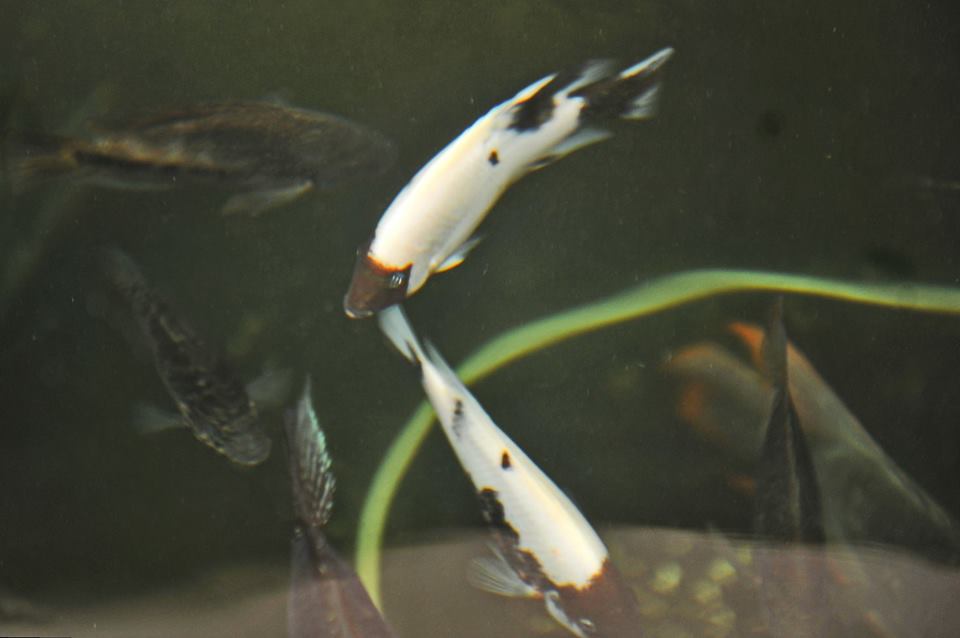
   These are Crossbreed fish between male Marble Fenestratus and female Synspilum , Look like " Cow Patten " , Do you love it ?  ^ _ ^


You can borrow for free my online aquarium article at Amazon.com
by join Amazon Prime ^ _ ^


Fish Data : Firemouth Cichlid


The firemouth cichlid (Thorichthys meeki) is a species of cichlid fish native to Central America. They occur in rivers of the Yucatán Peninsula, Mexico, south through Belize and into northern Guatemala.

   Their natural habitat is typically shallow, slow-moving, often turbid, water with a pH of 6.5 - 8.0. It has also been reported to live in underground cave systems. As fish with a tropical distribution, firemouth cichlids live in warm water with a temperature range of 23–30 °C (75–86 °F). The common name, firemouth, is derived from the bright orange-red colouration on the underside of the jaw. Males in particular flare out their gills, exposing their red throats, in a threat display designed to ward off male rivals from their territory.

   The Firemouth is so named due to the fiery coloration on the underside of its mouth and throat. In addition, it has a vivid red coloration on the belly extending from the mouth to the base of the tail. The rest of the body is generally blue-gray with several black blotches while the fins are brown and streaked with blue. Slight differences in coloration are present on particular fish depending on where the fish originated.

   This is a great fish for both beginning fish keepers and advance aquarists alike. It is generally a peaceful cichlid and makes for a suitable addition to a large community tank. It's best kept with its own kind and other large and similar tempered species. The one time when these fish tend to become more than marginally aggressive is when they are attempting to spawn. During breeding they can turn aggressive towards other fish and are especailly threatening towards smaller members of their own species.

   During spawning the male Firemouth Cichlid is even more vivid in appearance as he displays an impressive bluff. A 'bluff' is an aggressive stance where he inflates his fiery red throat sac and gill covers to impress females and ward off competitors. It has been discovered by ethologists, scientists who study animal behavior, that just this red coloring alone is intimidating to other fishes!
Firemouths like to burrow on occasion, so it's best to provide a substrate of fine sand for them to dig and nest in. They will also appreciate a number of hiding places and caves formed out of rocks, wood, or any other type of aquarium decoration. Although they like to have some living plants in their tank, make sure the plants are potted so as to avoid them being uprooted if the Firemouth happens to dig around their roots. Place hardy plants, such as Sagittaria, around the inside perimeter leaving an open area in the center for swimming.

    The body of the Firemouth Cichlid is strongly compressed laterally with a sloping forehead emphasizing a sharply pointed mouth and accented by broad and pointed dorsal and anal fins. They are known to reach up to about 6.5" (17 cm) in the wild, making them a moderately sized Central American cichlid, though they tend to be a bit smaller in captivity with males reaching about 5" (12.7 cm) and females about 4" (10.15 cm). They have a life span of about 10 - 15 years.

    The eponymous coloring of the Firemouth cichlid presents along the underside of the fish, extending from the mouth along the body to the base of the tail. The rest of the body is generally blue-gray with several black blotches while the fins are a light brown accented with streaks of metallic blue. Note that depending upon where the particular fish came from or where its parentage originated, it may have some slight coloration differences. Males have more pointed dorsal and anal fins and are more intensely colored, especially during breeding.

    All cichlids, along with some saltwater fish such as wrasses and parrotfish, share a trait of a well-developed pharyngeal set of teeth located in the throat, along with their regular teeth. Cichlids have spiny rays in the back parts of the anal, dorsal, pectoral, and pelvic fins to help discourage predators. The front part of these fins are soft and perfect for precise positions and effortless movements in the water as opposed to fast swimming.

   Cichlids have one nostril on each side while other fish have 2 sets. To sense "smells" in the water, they suck water in and expel the water right back out after being "sampled" for a short or longer time, depending on how much the cichlid needs to "smell" the water. This feature is shared by saltwater damselfish and cichlids are thought to be closely related.

   This fish is not picky when it comes to fish food. Flakes, live and frozen foods are taken with gusto. There are many fish foods (pellets, sticks) made especially for cichlids that can be a great source for most of the vitamins, minerals and other nutrients they need to thrive. 

 Credit :

http://animal-world.com/encyclo/fresh/cichlid/firemouth.php

https://en.wikipedia.org/wiki/Firemouth_cichlid

https://www.fishlore.com/profile-firemouthcichlid.htm

 https://www.aquariumfactory.com.au/product/firemouth-cichlid/

*************************************************************

You can borrow for free my online aquarium article at Amazon.com
by join Amazon Prime ^ _ ^

 https://www.amazon.com/s/ref=nb_sb_noss_2?url=search-alias%3Daps&field-keywords=kasidit+wannurak


วันอังคารที่ 17 กุมภาพันธ์ พ.ศ. 2558

Fish data : Electric Blue Jack Dempsey Cichlid


The Electric Blue Jack Dempsey cichlid Rocio octofasciata cf. (previously Cichlasoma octofasciatum) is considered to be one of the most beautiful freshwater aquarium fish. The adult displays a magnificent blue coloration, and is definitely one of the 'bluest' freshwater fish in the hobby. It has a dark brown background that is covered with brilliant metallic and iridescent blue flecks. It will reach a maximum length of a little more than 8" (20 cm), or slightly smaller than its genetic progenitor,the Jack Dempsey.These fish are also called the Blue Dempsey, Electric Blue Dempsey, and Jack Dempsey Neon Blue.

This dazzling fish is a naturally occurring variant of the Jack Dempsey. According to popular rumor, fry which displayed the bright blue coloring of the Electric Blue Jack Dempsey were considered to be malformed and runtish and were discarded by their keepers as inferior specimens. Fortunately for those hobbyists who appreciate the stunning coloration of these fish, and for the hobby in general, this archaic and incorrect view has been largely discarded and these fish are now being actively bred and developed in captivity. Though the Blue Dempsey is relatively easy to breed, it does take a considerable amount of time, luck, and a well designed aquarium set up, so these fish are rather rare and quite a bit more expensive than many other tropical fish, include the Electric Blue Jack Dempsey's progentitor species, the Jack Dempsey.

The Blue Dempsey is a bit more delicate than its parentage. But just like its progenitors, it likes a tank bottom of fine sand to burrow in and create nests out of. It also needs plenty of hiding places among rocks and wood, and a cover of floating plants. However they will enjoy snacking on any plants in the aquarium, so it is reccommended to monitor the status of any plants sharing the tank with a Blue Dempsey.

This cichlid, true to its family, tends to be semi-aggressive and will appreciate being kept in a large aquarium with similarily sized and tempered tankmates. That being said, it generally is not quite as aggressive as many cichlids and can be shy at times. Thus, it is best to either keep it singly or in a large group with only a few other tankmates.

The Jack Dempsey Rocio octofasciata (previously Cichlasoma octofasciatum) was described by Regan in 1903. This species is not listed on the IUCN Red List. They are found in North and Central America; Southern Mexico, Guatemala, Yucatan, and Honduras. Feral populations have been found in the USA, Australia, and Thailand as well. They inhabit bogs and other warm, slow moving, and swampy waters, living among weedy areas with sandy or muddy bottoms. They feed on worms, crustaceans, insects and fish.

The Electric Blue Jack Dempsey is a naturally occurring color-morph of the Jack Dempsey which has often been bred in captivity. It is said that for a long time hatched fry with this bluish coloration were consider runts and were discarded. This is no longer the case and in fact the fry which display the Electric Blue coloring usually sell for higher prices when mature. They are relatively easy to breed but take a lot of time and the right set-up, so they are more rare and costly than their parentage. Other common names are Blue Dempsey, Electric Blue Dempsey, and Jack Dempsey Neon Blue.

Just like its parentage, the body of the Electric Blue Jack Dempsey is stocky and compact. However this variety is a little smaller reaching closer to the 8 inches (20 cm) in length, rather than the almost 10 inches (25 cm) of a full size Jack Dempsey fish. They generally have a life span of 10 - 15 years.
This beautiful variant exhibits a coloration comprised of mostly 'blues' rather than the 'greens' seen on the normal Dempsey cichlid. They have a dark brown background contrasted with brilliant metallic and iridescent blue flecks. Males develop long pointed dorsal and anal fins and may also have a round black spot in the center of the body and at the base of the tail. Juveniles are less brilliant, having a white to light tan background with faint turquoise to blue flecks that get bolder with age.

If stressed or moody these fish can exhibit great color change in the aquarium, and also with age. Stressed fish will be lighter and their spots will be less striking.

A minimum 40 gallon aquarium is suggested, though a larger tank would be suggested if keeping them in a semi-aggressive community tank with other like sized fish. They need good water movement along with strong and efficient filtration.

Although Dempsey's can tolerate a fairly wide range of conditions, it has been suggested that warmer temperatures lead to more aggression in this fish. Many aquarists will keep the maximum aquarium temperature below 78° F (26° C) to help reduce antagonism.

Provide a bottom of fine sand and plenty of hiding places among rocks and wood. Plants are appreciated but should be hardy, such as Sagittaria. Place the plants around the inside perimeter leaving an open area in the center for swimming. The plants should be potted to protect the roots.
The Electric Blue Jack Dempsey is a rewarding specimen for the aquarist as it is moderately easy to keep as long as the aquarium is maintained.

Though the aggressively territorial Jack Dempsey is not considered a good community fish due to their proclivity to defend their territory, the Electric Blue Jack Dempsey has demonstrated a much more tolerant attitude towards tankmates. That being said, as this fish ages it can tend to become more territorial and aggressive, especially when it is time for them to spawn. If they become too aggressive to cohabitat with the other members of the tank, it is recommended they be transfered to a species only tank. If keeping more than one, it is easier and safer for them to keep them in large groups rather than in pairs.

The author has successfully kept an adult Electric Blue Jack Dempsey with a 12" Peacock Eel, a 10" Chocolate Plecostomus, and a 4" Upside-down Catfish for several years. They get along very well.

The Electric Blue Jack Dempsey Cichlid has been bred in captivity. They are one of the easiest cichlids to get to spawn but as pairs they can become territorial, intolerant, and biters.
The Dempsey fish are egg layers. The female will lay 500-800 eggs on carefully cleaned rocks. They form a nuclear family. The fry are kept in pits and are guarded by both the male and female in the manner of "monogamous cichlid" breeders.

They are subject to infections as well as other diseases that ail all freshwater fish. One common problem is Ich. It can be treated with the elevation of the tank temperature to 86° F (30° C) for a few days since they can tolerate higher temperatures. They are prone to the same diseases as discus. Head and Lateral Line Erosion (HLLE), which was previously called "hole-in-the-head" disease. is common with poor water conditions. HLLE presents as cavities or pits on the head and face. It is believed this may be caused by a nutritional deficiency of one or more of: Vitamin C, Vitamin D, calcium, or phosphorus. In addition, it is thought to be caused by a poor diet or lack of variety, lack of partial water changes, or over filtration with chemical media such as activated carbon.

As with most fish the Blue Dempsey Cichlids are prone to skin flukes and other parasitic infestations (protozoa, worms, etc.), fungal infections, and bacterial infections. It is recommended to read up on the common tank diseases. Knowing the signs and catching and treating them early makes a huge difference. For information about freshwater fish diseases and illnesses


  Credit :

http://www.cichlids.com/uploads/tx_usercichlids/user_pics/1368/1368____file_01_dads_pics_1_491.jpg


http://animal-world.com/encyclo/fresh/cichlid/ElectricBlueJackDempsey.php

*********************************************************************************

You can borrow for free my online aquarium article at Amazon.com
by join Amazon Prime ^ _ ^

 https://www.amazon.com/s/ref=nb_sb_noss_2?url=search-alias%3Daps&field-keywords=kasidit+wannurak


Fish Data : Convict Cichlid


The Convict Cichlid Amatitlania nigrofasciata (previously Archocentrus nigrofasciatus and Cichlosoma nigrofasciatum), a.k.a. the Zebra Cichlid, is a hardy fish with a pugnacious attitude. Their name, Convict Cichlid, originates from the broad, dark vertical lines running down their body, making them similar in apperance to the traditional "jailbird" outfit. When mature, they reach a maximum size of about 5-6" (13-15 cm) which makes them one of the smaller Central American cichlids. The male Convict will be larger than the female, but the females will be more colorful. There are also several color varieties being bred. The popular pseudo-albino forms are known as the Pink Convict Cichlid or White Convict Cichlid.

Convict Cichlids have a tendency towards unusually aggressive and spunky behaviors for a fish their size. For example, they are known for their tendency to attack almost any other fish in their territory, including fish up to three times their size! They are great in a tank with other aggressive fish, just make sure the other fish are not so big that they can swallow your Convict Cichlid whole.
These are an undemanding fish and very easy to care for. A sandy substrate with rocks, roots, and pieces of driftwood will make your Convict Cichlid feel at home. They enjoy plants, especially floating plants to help subdue the light. They will re-arrange your tank however, so be sure to anchor planted plants to the bottom of the tank as the Convict Cichlid sometimes likes to remove the gravel and substrate keeping the plant anchored to the bottom. Convict Cichlids prefer a warm tank and can tolerant a wide range of pH, pretty much anywhere from 6.0 to 8.0, though it needs to be kept reasonably consistent.

One of their most notable characteristics is that they are one of the easiest fish to breed and generally don't even require aid from the aquarist. Due to the extreme ease of breeding, these fish have been called the 'rabbits of the fish world'. They have the reputation of "spawning in the bag on the way home from the fish store". This statement is a bit of a stretch, but not far from reality. 
Although they are small, beautiful, and easy to keep and breed, the Convict Cichlid is also very aggressive. Fishkeepers, especially begginners, should therefore be well informed when choosing this fish as a pet and be mindful of their tendencies and particulars when deciding on tankmates and aquarium setup. 

The Convict Cichlid Amatitlania nigrofasciata (previouslyArchocentrus nigrofasciatus and Cichlosoma nigrofasciatum) was described by G{uuml}nther in 1867. They are found in Central America on the Pacific slope from Costa Rica to Guatemala and on the Atlantic slope from Honduras to Panama. These fish have been introduced to many areas in the United States by fish owners and local American populations are growing. Another common name for this fish is the Zebra Cichlid. The pseudo-albino variety is known as the Pink Convict Cichlid or White Convict Cichlid. This species is known to cross breed with theNicaragua Cichlid Hypsophrys nicaraguensis and the crosses are fertile to at least the 4th generation. The species is not listed on the IUCN Red List.

Until the mid 1980's there were some 100+ species that were described under the genus Cichlasoma. But around this time it was determined that they no longer fit in that genus and were moved into their own various genera. Many were left orphaned and are now temporarily designated as "Cichlasoma" (with quotation marks) until the scientific community decides what genus to place them in. This allows only true Cichlasoma to remain in this 'corrected' genus, currently comprised of 12 species.

The rivers they inhabit are the Tarcoles, Aguan River, and Guarumo River. They like waters that are flowing from smaller streams to larger fast flowing rivers. They dwell among the shallow rocky areas where they hide in cracks and crevices, feeding on worms, insects, fish, crustaceans and plants. They can also be found in warm pools of springs. These fish are almost never found in open waters and prefer areas with some sort of coverage.

The Convict Cichlid has a stocky oval disk shape, with pointed anal and dorsal fins. This is one of the smaller Central American cichlids, with the males only reaching 5 - 6" (13 -15 cm) in length and females a bit less at 3 - 4" (8 -10 cm). They are also very deep bodied so it's easy to underestimate their actual size. They have a general life span of 8 - 10 years, though there have been reports of individuals living up to 20 years.

This cichlid has a blue-gray, cream, or blue-lavendar base on the body with 8 to 9 dark vertically running bands. They have a break in the vertical bands in the area behind their head, almost forming a "U" shape. The fins are clearish to light yellow.

With in-line breeding there are now several color varieties. The Pink Convict Cichlid or White Convict Cichlid are pseudo-albino varieties that are pink and cream, and lack the characteristic vertical bars. The coloring of the male is monotone while the female will have an orangish patch on the stomach.
All cichlids, along with some saltwater fish such as wrasses and parrotfish, share a common trait of a well-developed pharyngeal set of teeth located in the throat, along with their regular teeth. Cichlids have spiny rays in the back parts of the anal, dorsal, pectoral, and pelvic fins to help discourage predators. The front part of these fins are soft and perfect for precise positions and effortless movements in the water as opposed to fast swimming.

Cichlids have one nostril on each side while other fish have 2 sets. To sense "smells" in the water, they suck water in and expel the water right back out after being "sampled" for a short or longer time, depending on how much the cichlid needs to "smell" the water. This feature is shared by saltwater damselfish and cichlids are thought to be closely related.

The Convict Cichlids are fairly easy to care for provided their water is kept clean. Aquariums are closed systems and regardless of size all need some maintenance. With home aquariums the nitrate and phosphates build up over time and the water hardness increases due to evaporation. Because these fish are very sensitive to pollutants and pH instabilty, so it is important that at least 15- 20% of the tank water is replaced bi-weekly, especially if the tank is densely stocked. When doing the water changes always use a gravel cleaner to ensure all of the decomposing organic matter that has built up is removed. The majority of of problems that occur with tropical fish tanks usually come down to one cause: decomposing organic matter!

Convict Cichlids do best when they are allowed plenty of space and a large aquarium. A pair of juveniles can do well in a tank as small as 20 gallons. However, it is recommended that once they become fully grown that they be moved to a tank of around 50 gallons or more. They prefer to have good water movement and efficient filtration. They like a warm tank and can tolerant a wide range of pH, pretty much anywhere from 6.0 to 8.0, though it needs to be kept reasonably consistent.
This cichlid has some salt tolerance and can be kept in slightly brackish water conditions. However it is not suited to a full brackish water tank. It can tolerate a salinity that is about 10% of normal a saltwater tank, a specific gravity of less than 1.0002.

Provide a sandy substrate with rocks, roots, and pieces of driftwood. They also enjoy plants, especially floating plants to help subdue the light. They will re-arrange the aquarium so make sure substrate plants are anchored down. Normal aquarium lighting works fine if there are floating plants, and low to moderate lighting if no plants.

Convict Cichlids are cave spawners. They will readily breed in captivity and are one of the best cichlid parents around. One author's very descriptive remark is that to breed them you "just add fish and water". A group of juveniles will result in a pair being formed, leaving the remaining fish cowering in the corner if the tank is small.

The pair will shake their heads at each other in a little pre-spawning dance. The male will position himself vertically and change to darker, more vivid shades of color. The female will do the same dance and flare up. They will then clean an area and dig a depression in the substrate around a rock, flower pot, or cave. The female will lay about 20-40 eggs on the inside top of the cave or flowerpot and the male will follow her up and fertilize them. This will continue until there are 100-300 eggs, depending on the maturity of the female. She will fan the eggs while the male keeps an eye on the nest and patrols the outside.

Depending on temperature and pH, the young hatch in about 48 to 72 hours. Within another 6-8 days they are free swimming and can be fed powdered (crushed) flake, daphnia, baby brine shrimp, and/or pellet food for omnivorous cichlids. They can be advanced to full flake at about 3 weeks old. The female helps out by stirring up the sand with her belly to expose food that has settled at the bottom, or by chewing up food that is too large and spitting it into the water for the young to eat. The parents also secrete a mucus like substance on their bodies that is a sort of supplementary food for the fry. 
The parents defend their babies at all cost and will push tank mates to the other side of the tank. If they feel their young are threatened, they may actually bury them in the sand. They will retrieve any fry that stray from the nest and the male will viciously guard them to the death.

You can remove the fry after a few weeks if you plan to raise them, allowing the breeding process to start again. If you do not remove them the female sometimes will eat the young. This will result in the male attacking the female to the point where you may have to remove her or put in a divider. The young are ready to breed within a year.


 Credit :

http://www.mycichlidaquarium.com/wp-content/uploads/2013/02/301324201_6f66af03cb.jpg

http://animal-world.com/encyclo/fresh/cichlid/ConvictCichlid.php

*****************************************************************************


You can borrow for free my online aquarium article at Amazon.com
by join Amazon Prime ^ _ ^

 https://www.amazon.com/s/ref=nb_sb_noss_2?url=search-alias%3Daps&field-keywords=kasidit+wannurak